

An engineering project is judged by more than the quality of its design. Engineering project management applies established project methods to engineering work, coordinating the technical and operational elements needed to take a defined project from initiation to closure. It covers the whole project, not just the engineers or their technical tasks.
Project management and engineering management involve different responsibilities. Engineering project management coordinates delivery of a defined outcome, while engineering management focuses on engineers and ongoing engineering activities in regular operations. A project engineer contributes technical expertise to the team, a distinct role from that of the project manager.
This guide explains what engineering project management involves, how it differs from engineering management, and how a project typically progresses through its lifecycle. It also covers planning and execution responsibilities, including coordinating schedules, documentation, materials and costs, so you can see how technical decisions support the wider delivery objective.
Key Takeaways
- Understand how project management methods coordinate the technical and operational work of an engineering project from start to finish.
- Distinguish a defined project with a clear end point from the ongoing engineering activities managed as part of regular operations.
- See how initiation, planning and execution establish the scope, resources and controls that guide delivery.
- Learn how monitoring, change control and closure help keep work aligned with requirements and capture outcomes for future projects.
- Identify the project manager’s role in coordinating schedules, purchasing, approvals, budgets and specialist engineering input.
Definition of engineering project management
Engineering project management applies standard project methods to engineering projects. It coordinates technical work with scope, schedule, resources, decisions and delivery requirements. The project manager keeps these elements connected from initiation to closure, rather than treating design, procurement and implementation as isolated tasks. A defined outcome gives the team a basis for planning and measuring progress.
Consider the design of a new office building. Engineers develop technical solutions, while the wider project team aligns design decisions with requirements, approvals, materials, timing and budget. A change to a building system may affect drawings, purchasing and installation planning. Engineering project management makes these dependencies visible, so decisions can be assessed across the project rather than within one discipline alone.
Engineering project management covers the full project, including non-engineering work needed to deliver its outcome. Construction project management focuses on coordinating construction delivery, such as site activities, trades and work sequencing. The two can overlap on a building project, but engineering project management also applies to projects that do not involve construction.
Australian laws, standards and regulations depend on the project’s location, industry, scope and technical risks. During initiation, the team identifies applicable requirements and records how design, approvals and delivery will address them. No single checklist applies to every engineering project.
There is no single qualification required for every project role in Australia. An engineering degree can provide technical grounding, while project management knowledge helps coordinate scope, risk and delivery. Education can support entry into the field but is not necessarily required. Someone with project management experience can manage an engineering project when engineering subject matter experts provide the technical knowledge. A person who already holds a Project Management Professional (PMP) certification is unlikely to need additional education for this work.
Software choices depend on the project’s control needs. A team may use scheduling tools to track activities, cost systems to monitor expenditure, and document platforms to manage drawings and approvals. For example, a design revision needs a clear record of its status, reviewer and effect on related tasks. The right system is one that supports reliable coordination across the team.
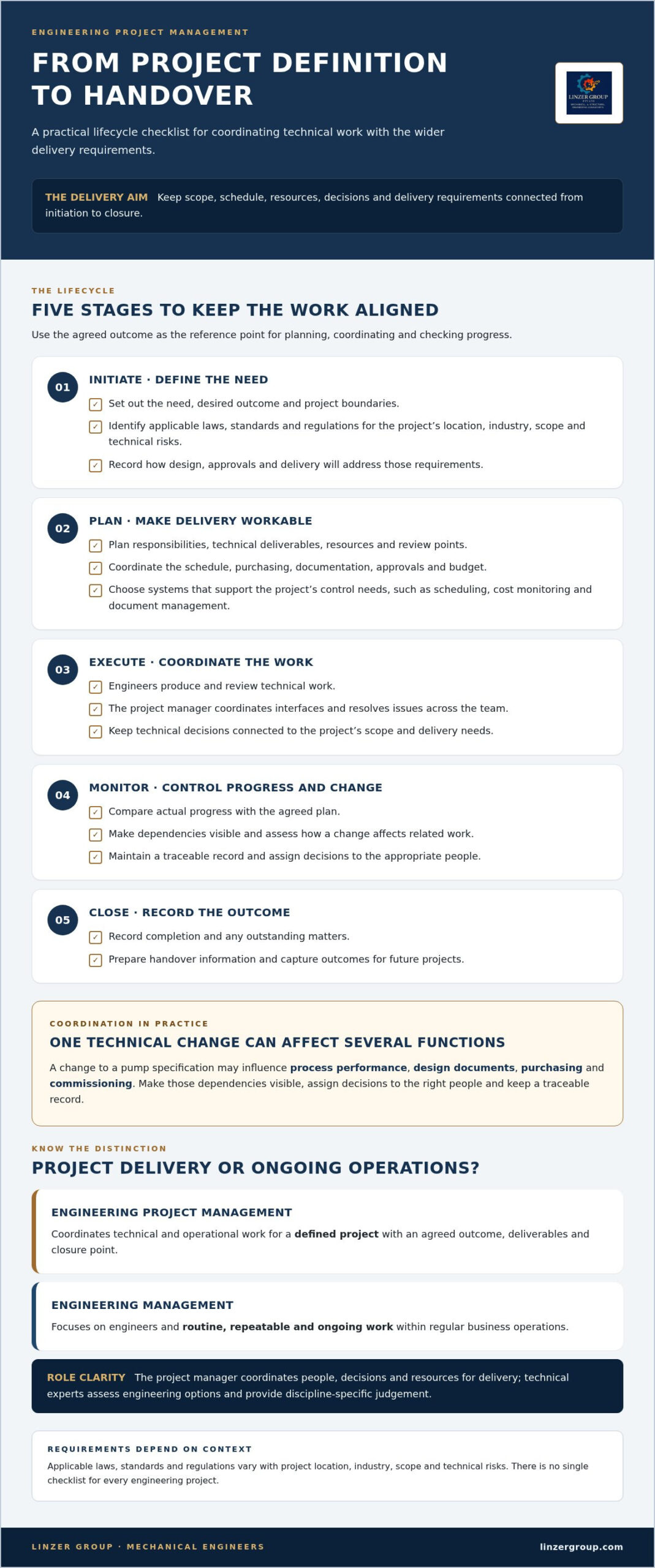
A practical lifecycle starts by defining the need, desired outcome and boundaries. The team then plans responsibilities, technical deliverables, resources and review points. During execution, engineers produce and review work while the project manager coordinates interfaces and resolves issues. Monitoring compares actual progress with the agreed plan, and closure records completion, outstanding matters and handover information.
Coordination is especially valuable when a technical decision affects several project functions. A change to a pump specification, for instance, may influence process performance, design documents, purchasing and commissioning. The project manager makes these dependencies visible, assigns decisions to the appropriate people and maintains a traceable record. This helps the team understand how each engineering choice supports the project’s defined outcome.
Engineering project management versus engineering management
The distinction lies in the work being managed. Engineering project management covers all aspects of a defined engineering project, including technical work and the activities needed to deliver its outcome. Engineering management focuses on engineers and tasks that are routine, repeatable and ongoing within regular business operations. One supports temporary delivery; the other supports continuing work.
Consider an industrial plant planning a new process system. The project manager coordinates scope, schedule, purchasing, documentation and delivery across the project. Engineering management, by contrast, may organise the plant’s ongoing maintenance engineering, recurring inspections and continuous technical support. The same engineers can contribute to both, but the objectives and time horizons differ.
Project boundaries help clarify which approach applies. A defined upgrade with an agreed outcome, deliverables and closure point is a project. Engineering project management lets the team track progress against that outcome and resolve dependencies between design, procurement and implementation. Routine changes handled through established operating processes usually fall within engineering management, unless they form part of a larger, separately managed project.
The roles also differ in their scope of authority. A project manager coordinates the people, decisions and resources required for delivery, but doesn’t necessarily approve engineering calculations or design choices. A lead project engineer may oversee and approve technical components, particularly when the project manager doesn’t have an engineering background. Clear decision rights keep delivery coordination distinct from technical approval.
An engineering background isn’t essential for every project manager. Someone with project management experience can manage an engineering project when engineering subject matter experts provide the technical knowledge. The manager’s skills centre on coordination, planning, communication and control; engineers assess technical options and provide discipline-specific judgement. Engineering project management works best when these responsibilities are clear.
For example, a project manager may coordinate a process-system modification while mechanical and process engineers assess its technical effects. The lead project engineer can review the design basis and approve engineering components within their responsibility. The manager then incorporates the resulting decisions into the schedule, documentation and procurement plan. This division connects technical authority with delivery accountability without making one person responsible for every decision.
Some assignments combine both management needs. A project may introduce new equipment while the site’s engineering team continues maintenance and operational support. Project controls govern the defined installation, while engineering management maintains recurring work. Separate plans and reporting lines help teams distinguish delivery activities from ongoing operations.
When a project needs coordinated delivery and technical input, integrated project coordination can help connect those responsibilities with engineering work.
Monitoring, controlling and closing projects
Monitoring compares actual work with the project plan, while control manages differences and approved changes. Common risks include technical changes, delayed materials and unclear responsibilities. Teams manage them by tracking dependencies, assigning owners and reviewing impacts before making decisions.
Project monitoring and control
Project monitoring and control is the ongoing review of progress, performance and changes against agreed requirements. It matters because even a small variance, such as a delayed component, can affect later engineering work and planned commissioning. Regular reviews help the team identify emerging issues while there’s still time to adjust the sequence or resources.
Useful controls connect each deliverable to its status, responsible person and acceptance criteria. For example, a technical drawing may be awaiting review while purchasing depends on its approval. Recording that relationship helps the project manager assess schedule effects and assign follow-up. Change control gives the team a consistent way to assess a proposed design revision before updating documents or work plans.
Project closure
Project closure is the formal process of confirming agreed work is complete, recording remaining matters and transferring relevant information to the operating team. It matters because an installed system still needs usable records and clear ownership. A closure review can compare the delivered work with the approved scope and identify documentation that needs completion.
For an equipment upgrade, closure may include collecting final drawings, recording test results and documenting outstanding actions. The team can also capture lessons about design coordination, procurement timing or review processes. These records give asset owners a clearer basis for operating and maintaining the system, while future project teams can use practical findings to improve their planning.
Engineering project risks
Engineering project risks are uncertain events that could affect technical performance, scope, schedule or cost. Their effects can cross disciplines: a late design decision may delay purchasing, while a specification change may require updated drawings and additional review. Identifying these links helps the team prioritise risks by their potential effect on delivery and operational readiness.
Risk management begins by describing each risk clearly, assessing its likelihood and consequence, then assigning an owner and response. For example, if a critical component depends on a long procurement process, the team can track its specification and approval status through project controls. If a design change emerges, engineers assess its technical implications before the manager incorporates approved decisions into affected plans.
Risk reviews should continue as project conditions change. A new interface, revised technical requirement or unresolved approval can alter earlier assumptions. The team records the issue, evaluates its effect, assigns an action and follows up at the next review. This ongoing process keeps risks visible and connects technical judgement with delivery decisions, rather than leaving concerns in informal discussions.
Project initiation, planning and execution
Initiation establishes the need, intended outcome and boundaries; planning translates them into coordinated work. During execution, the team carries out the plan while managing technical decisions and delivery dependencies.
Project initiation and delivery
Project initiation defines the problem, desired outcome, scope and decision-making responsibilities before detailed work begins. An agreed project basis helps the team distinguish essential requirements from later requests. For an industrial process upgrade, the initial brief might identify the operating issue, expected system changes and interfaces with existing equipment.
Planning then turns that brief into deliverables, responsibilities, resources, dependencies and review points. The team can organise engineering work around design inputs, technical reviews, procurement information and implementation needs. Engineers Australia identifies competency 6 for Chartered status as identifying, assessing and managing risks, knowledge that supports sound planning. Execution follows the agreed sequence, with technical work progressing through assigned responsibilities and documented decisions.
Engineering project manager responsibilities
An engineering project manager coordinates the delivery activities that connect technical work with the project’s agreed outcome. This matters because engineering decisions often affect purchasing, documentation and timing beyond the discipline that produced them.
Responsibilities may include managing schedules, materials purchasing, documentation approvals, budgets and costs. For example, if a drawing approval is needed before a component can be ordered, the manager tracks that dependency and coordinates the review. Engineering specialists provide subject-matter knowledge, while the manager keeps their work aligned with the delivery plan.
Project management methodologies
Project management methodologies provide structured ways to plan, coordinate and control project work. They give the team a shared approach, with controls tailored to the technical work and project conditions.
Predictive methods suit work where requirements and dependencies can be planned in advance; iterative approaches allow design or development to be refined through review cycles. A hybrid approach can combine planned approvals with iterative technical development. For example, an equipment modification might follow defined design reviews while selected details are developed through engineering analysis. The team chooses an approach based on requirements, uncertainty and interfaces.
Managing budgets, schedules and scope
Budget, schedule and scope management connects approved work with the resources and time needed to deliver it. This matters because a change to one area can affect the others, altering procurement, design effort or planned activities.
The team defines deliverables and estimates the resources and work sequence needed for each. During execution, it compares progress and costs with the plan and assesses proposed changes for their effects on scope, timing, purchasing and technical requirements. For instance, adding a process-system requirement may call for revised design work and new approvals. Recording the decision and updating affected plans helps maintain a consistent delivery basis.
What are the main responsibilities of an engineering project manager?
An engineering project manager coordinates the people, information and controls needed to deliver a defined technical outcome. For a plant upgrade, this means connecting engineering deliverables with purchasing, approvals, schedules and cost management, while technical specialists remain responsible for discipline-specific judgement.
The role turns project objectives into coordinated work. At the outset, the manager establishes responsibilities, reporting pathways and decision points. During delivery, they track dependencies, help resolve issues and communicate changes to affected team members. For example, a revised equipment specification may affect design documents, procurement and installation planning, so each consequence needs to be identified and managed.
Scheduling is a core responsibility. The manager organises activities in a logical sequence, tracks dependencies and monitors progress against the plan. If design approval must precede materials purchasing, that relationship needs to appear in the schedule. A delayed review can then be assessed for its effect on later activities, rather than treated as an isolated administration issue.
Materials purchasing also requires coordination. The manager aligns purchasing needs with technical specifications, approval status and the delivery sequence. For example, ordering against an outdated drawing can create rework or an interface mismatch. Clear document control and communication between engineering and procurement keep purchasing decisions connected to current project information.
Documentation approvals are another essential control. Engineering drawings, specifications and other project records need defined review responsibilities and traceable decisions. The manager tracks who must review each document, its status and any dependencies. This supports orderly handovers between design stages and helps the team work from approved information.
Budget and cost management involve monitoring planned expenditure and assessing the financial effect of proposed changes. If a design revision requires additional engineering effort or different materials, the manager records the change and updates relevant forecasts and plans. This connects cost discussions to the technical decision and its effect on project scope.
Communication brings these responsibilities together. A project manager shares relevant status information with engineers, asset owners, procurement personnel and other stakeholders. A concise progress review can identify a pending approval, its owner and the work it affects. Clear records reduce reliance on informal conversations and give team members a consistent view of decisions and actions.
Technical authority must remain distinct from delivery coordination. When an engineering decision affects safety, performance or compatibility, the appropriate subject-matter expert assesses its technical basis. The project manager ensures the decision is recorded, communicated and reflected in affected schedules, documents and purchasing activities.
For support coordinating engineering work, discuss project and engineering management for your project.
Linzer Group: Project and Engineering Management
Linzer Group provides project and engineering management for teams coordinating technical work across an industrial project lifecycle. Its support is useful when project planning, engineering decisions and delivery activities need to stay aligned, or when a project needs additional design expertise.
Design and redesign, testing and simulations, and commissioning or de-commissioning can support work at different lifecycle stages. For example, a project involving a design change may need technical analysis before commissioning proceeds. Coordinating these activities helps teams account for engineering requirements as project work advances.
For coordinated engineering management or lifecycle support, contact Linzer Group to discuss your project requirements.
Shape the next stage of your project
Turn project priorities into a clear engineering brief. Identify the outcome you need, the technical decisions requiring attention and the interfaces between design and delivery that need coordination. This gives project discussions a practical starting point and helps align engineering work with operational requirements.
Linzer Group provides project and engineering management, design and redesign, and commissioning or de-commissioning. These capabilities support projects where technical development, lifecycle coordination and operational transition need to work together. The right focus depends on the project’s scope and stage.
Thoughtful engineering project management connects immediate decisions with the asset’s longer-term use. A well-defined next step can clarify responsibilities, surface key dependencies and support a more considered path forward. If you’re ready to discuss your project, start a conversation with Linzer Group.
Frequently Asked Questions
What is Engineering Project Management?
Engineering project management coordinates technical work and delivery decisions to achieve a defined engineering outcome. It connects engineering requirements with activities such as procurement, document review and operational handover. For example, a pump upgrade involves more than selecting equipment: the team must also consider process requirements, installation interfaces and the information operators need. The project manager coordinates these workstreams, while engineering specialists assess technical options and make discipline-specific decisions.
What are the stages of an engineering project lifecycle?
An engineering project lifecycle typically moves through initiation, planning, execution, monitoring and control, then closure. Teams may also use review gates between stages to decide whether work is ready to proceed. For a process-system modification, a gate might confirm that the design basis is understood before detailed design begins. Deliverables vary, but each stage should leave the next team with clear inputs, decisions and responsibilities.
How do you create an engineering project management plan?
Start by recording the project objective, boundaries, technical assumptions and people authorised to make decisions. Break the intended outcome into deliverables, assign owners and map dependencies, such as design approval before purchasing. Include how the team will track schedule, costs, document status, changes and risks. For an equipment modification, identify interfaces with existing systems early so design reviews and operational input are built into the plan.
Recent Comments